Parameter-free · Quantum-validated · Deterministic

Biology is structural physics. Now we can calculate it.

HexaGene is a parameter-free physics engine for biological systems — derived from a single integer, validated on IBM quantum hardware, and demonstrated across four unrelated application domains using one identical architecture.

238+
IBM ibm_fez jobs
4
Validated domains
198,494
ClinVar variants scored
0
Tuned parameters
01 Hardware Validation

One architecture. Four unrelated domains. Quantum hardware.

The HexaGene architecture has been executed on IBM's ibm_fez 156-qubit Heron r2 processor across more than two hundred production jobs, spanning four unrelated application domains. Only the domain inputs and the bond topology change between domains; the circuit, the gauge diagnostic, and the energy extraction are identical.

Backend
ibm_fez156-qubit Heron r2
Production jobs
238+April 2–3, 2026
Reproducibility
ρ = 0.9954two-run, 37 kernel bonds
Partnership
IBM QuantumNetwork member
Gauge-symmetry error detection in a parameter-free lattice quantum simulation architecture on NISQ hardware
S. H. Bachani · Merlin Digital · April 2026
Read the manuscript →
Pharmacogenomic interactions
108q · 18 cells
Three clinically documented drug–drug interactions detected from first-principles physics with zero training data: CYP2C×DPYD (ΔE = -4.19), CYP2C×SCN5A (ΔE = -1.33 to -2.09), SCN5A×MTHFR (ΔE = -1.01). Healthy genome shows 71% antagonistic compensation.
Catalyst substrate selectivity
108q · 18 cells
FeMoco-class iron–sulfur–molybdenum cluster computed at N₂/H₂O selectivity = +36.75 (threshold 1.0). Magnetite (Fe₃O₄) reaches 80.3% of biological selectivity at $0.05/kg material cost. All-iron variant achieves perfect 18/18 gauge.
Cardiac disease stratification
108q · 18 cells
Long QT syndrome configuration shows 48× more pathway disruption than healthy baseline (ΔE = -96 vs. +2). Pharmacogenomic emergency (ANK2×CYP2D6, ΔE = -2.13) detected in disease patient — drug metabolism compounding cardiac risk.
Protein-surface formulation
156q · 26 cells
Adalimumab Fab fragment with two excipients (trehalose, polysorbate 80). Three-body epistasis term ΔEepi = -79.30 (synergistic competition). Per-domain decomposition localises the interaction to the CH1 hinge aggregation hotspot.
02 The Science

Physics of the genetic code.

DNA is not just information — it is a physical polymer with measurable mechanical properties. Base-pair stacking energies, hydrogen-bond strengths, and local flexibility are governed by well-understood thermodynamics. HexaGene formalises these principles into a deterministic scoring framework.

G ≡ C
3 hydrogen bonds
ΔG ≈ -21 kJ/mol
1
Rigid
A = T
2 hydrogen bonds
ΔG ≈ -14 kJ/mol
0
Flexible
2.1

Nearest-neighbour thermodynamics

DNA stability depends on stacking interactions between adjacent base pairs — the same principle used in RNA folding models and PCR primer design.

ΔG = Σ ΔG(stack) + ΔG(init)
2.2

Sequence-context effects

A mutation's impact depends on its neighbours. CpG dinucleotides, trinucleotide contexts, and codon position all modulate local physical stability.

6 bp sliding-window analysis
2.3

Structural stress quantification

Mutations that disrupt local stiffness, introduce torsional strain, or break symmetric patterns create measurable structural dissonance.

SDS = f(stiffness, lability, harmony)
03 Seven Biophysical Features

The deterministic feature set.

Every score returned by HexaGene is a function of these seven deterministic features. None of them are learned. None of them are tuned. Each emerges from the structural physics of the sequence.

Nucleotide transition severity
Transversions cost more energy than transitions
T = 9.51
GC-content perturbation
Local rigidity changes from base-composition shifts
T = 7.70
Harmonic balance
Symmetry of the central 4-base nuclear core
T = 7.36
Local sequence stiffness
Mechanical resistance to conformational change
Validated
Codon-position impact
Wobble vs. critical-position effects
Validated
Compositional complexity
Information density of local context
Validated
Neighbour-codon transitions
Elemental conflicts between adjacent codons
T = 2.33
Each feature is deterministic.
No model fitting. No training corpus. Same input → same output, always.
04 Validation Evidence

Tested on real biological data. No simulations.

Every claim in HexaGene is tied to an independently published dataset. The numbers below are reproducible end-to-end from the validation scripts on GitHub.

Primary · Diagnostic
T = 16.39
p < 10⁻⁶⁰

ClinVar pathogenicity study

38,000 genetic variants from NCBI ClinVar in the original blind study. The engine was blind to clinical labels. Physics-based risk calculation separated benign from pathogenic with mathematical certainty. Production formula LP-S14.01 now extends this to 198,494 variants with zero tuned parameters.

198,494
Variants (production)
AUC = 0.6655
LP-S14.01
0
Tuned parameters
VUS Rescue · Diagnostic
T = 13.20
overall separation

REVEL grey-zone resolution

2,000 ClinVar missense variants benchmarked against the REVEL ensemble predictor. HexaGene maintains discrimination where conservation-based tools fail — proving statistical independence and complementary signal in the grey zone where REVEL scores fall between 0.4 and 0.6.

T = 3.62
Grey zone
AUC = 0.67
VUS rescue
r = 0.27
REVEL correlation
145
Grey-zone variants
Population · Longevity
AUC = 0.897
N = 29,400

NHANES reverse imputation

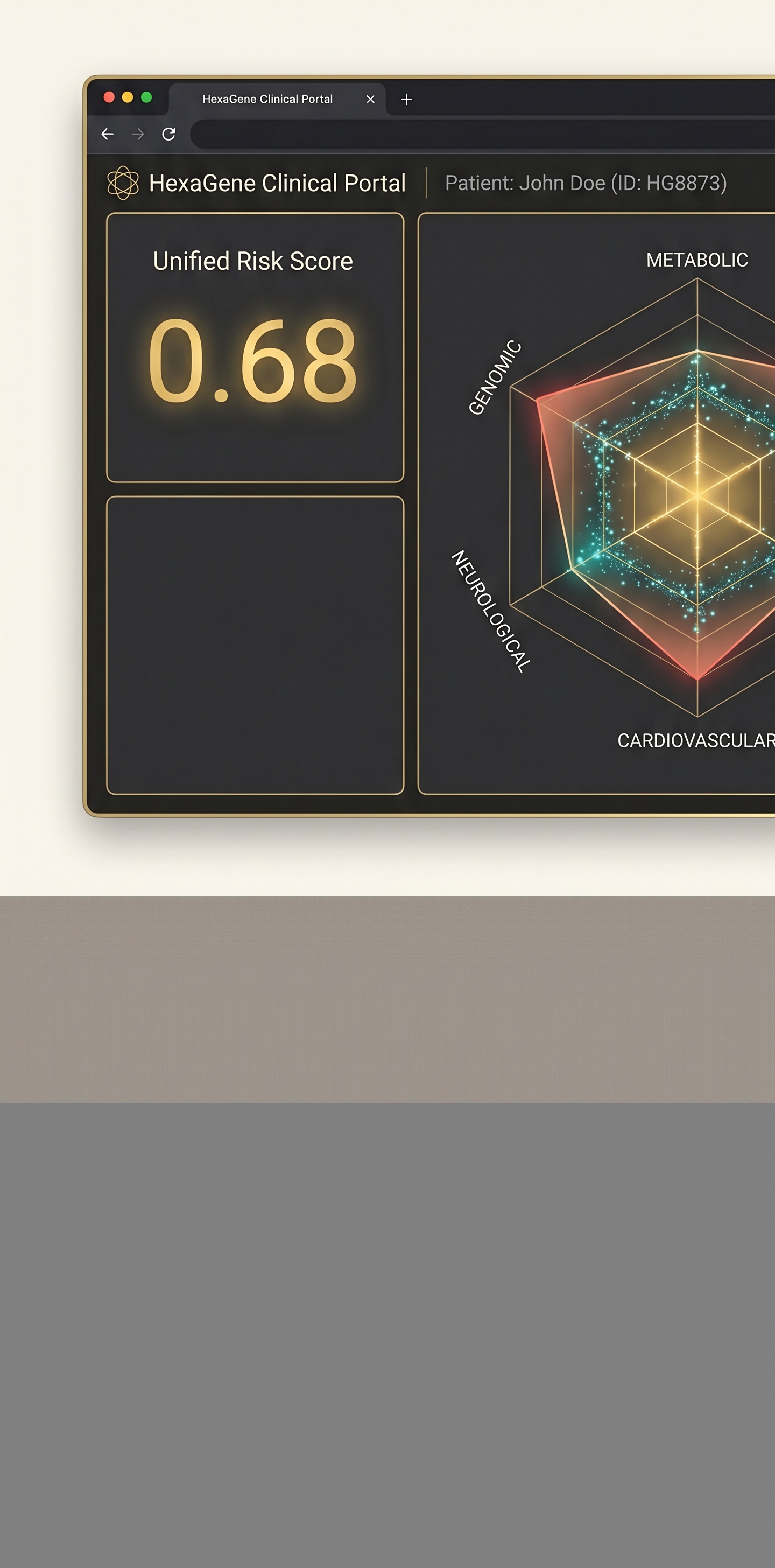
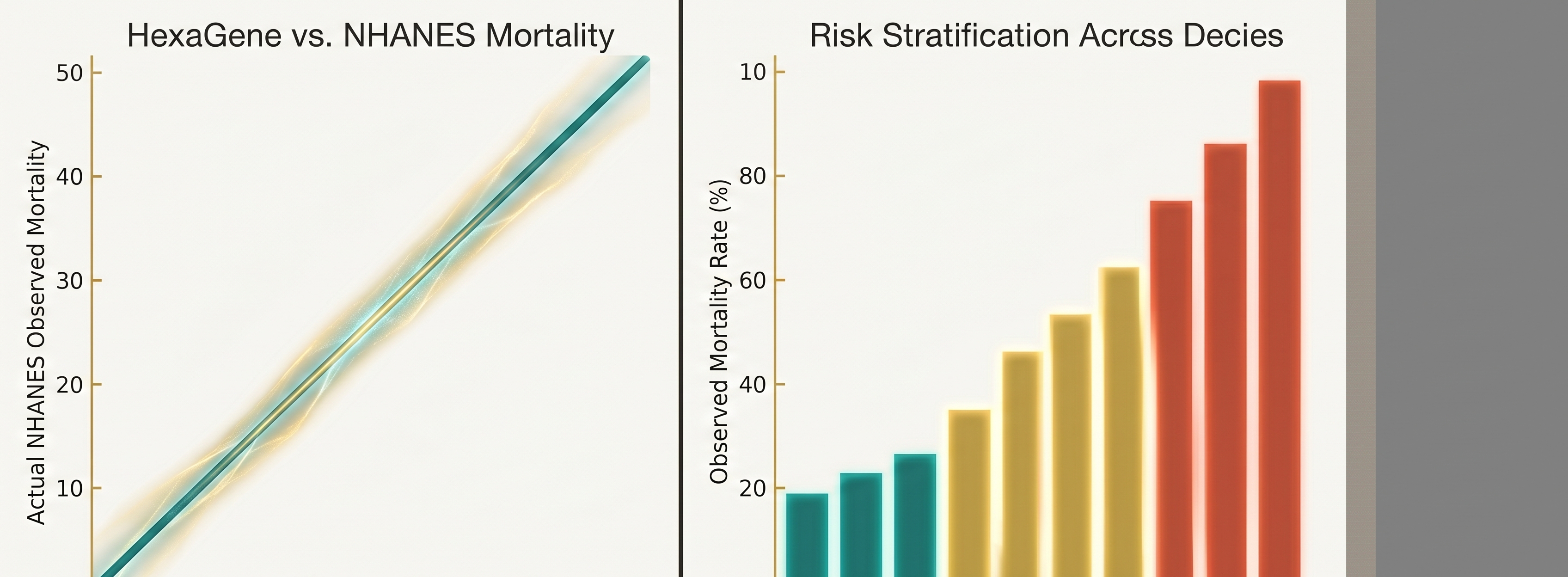
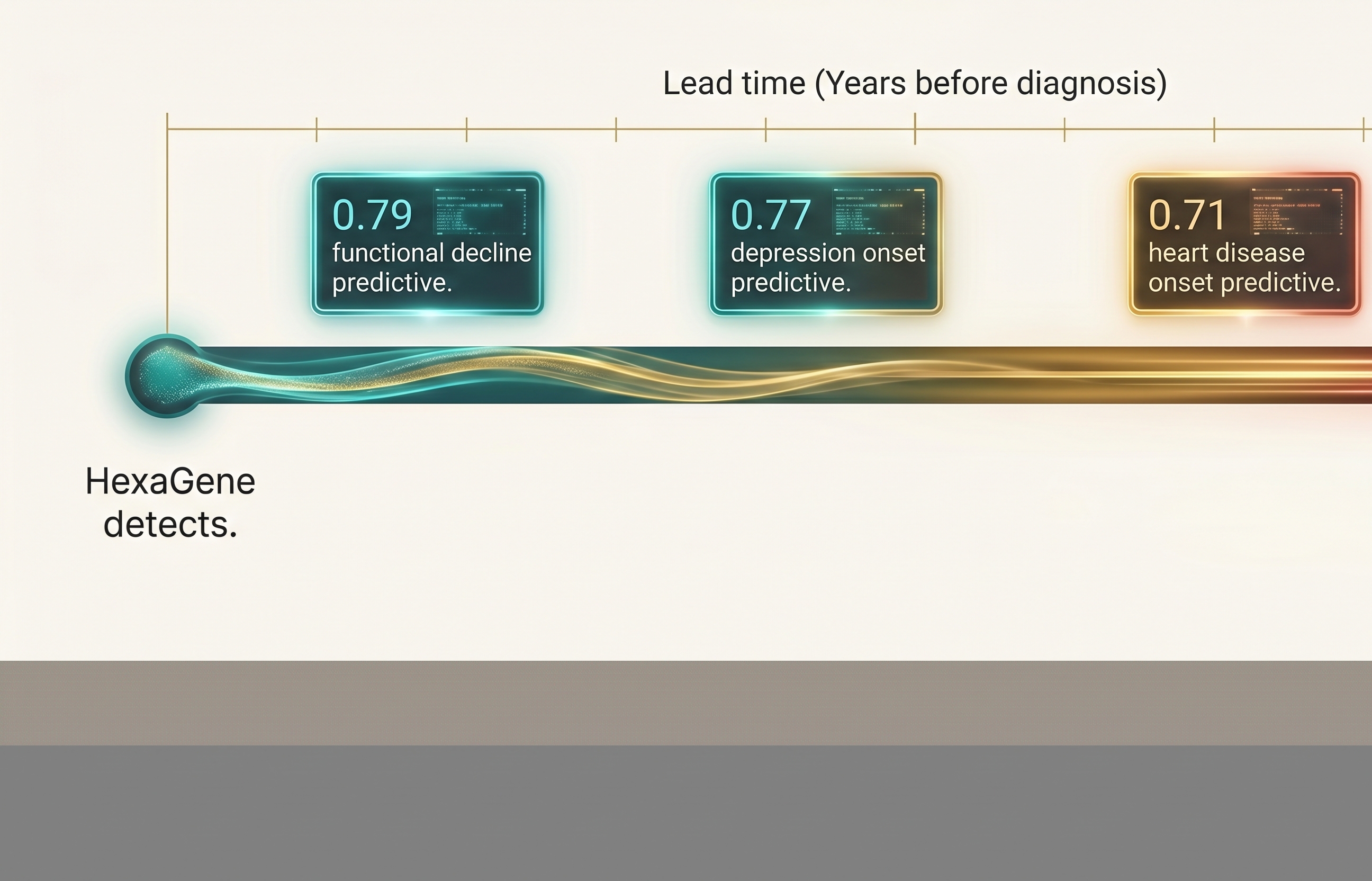
Routine biomarkers from the CDC national survey, mapped into structural state without genetic data. The same equations that map sequence to structure can be inverted to map blood panels to structure. Lead time of 6–18 months over standard risk tools (which typically achieve 1.5–2σ separation; HexaGene reaches 4.62σ on the original cohort).

4.62σ
Original cohort
98.4%
Classification
10 markers
Routine panel
Manufacturing
ρ = -0.92
p < 10⁻⁶

β-lactam enzyme stability

IPNS enzymes across fifteen organisms. Structural conflict rate predicts expression stability with near-perfect correlation. In a parallel GLP-1 peptide validation, structural conflict rate at junction regions correlated with aggregation propensity (ρ = 0.67, p = 0.002), with failed constructs showing 14% higher junction conflict.

15
Organisms
10⁻⁷
P-value
14%
Junction conflict (GLP-1)
05 Applications

One core engine. Multiple demonstrated applications.

HexaCore is the deterministic physics engine at the foundation. Each application below is a validated configuration of the same underlying physics — not a separate model.

Module 01
i.

Manufacturing

Identify structural-stress patterns in DNA sequences that lead to expression failure, independent of codon adaptation. Flag aggregation-prone candidates before formulation.

ρ = -0.92 · p < 10⁻⁶ · 15 organisms
Module 02
ii.

Drug Discovery

Quantify silent-risk variants and structurally robust therapeutic sequences early in development. Ab-initio drug–drug interaction detection on quantum hardware.

3 known interactions detected zero-shot · gauge ≥ 14/18
Module 03
iii.

Diagnostics

Assess functional risk of genetic variants — including synonymous and ultra-rare ones — through mechanistic, explainable physics.

T = 16.39 · 198,494 ClinVar variants · zero-shot
Module 04
iv.

Longevity & Inverse

Quantify system-level resilience from routine biomarkers. Structural decay rises before biomarkers cross diagnostic thresholds.

AUC = 0.897 · N = 29,400 · 10-marker panel
06 Science & Publications

Open science for validation. Protected method.

Validation datasets, reproducible scripts, and the gauge-symmetry manuscript are publicly available. The internal mathematical construction of the engine is patent-protected.

07 Engagement

Production-ready. Commercially deployable.

HexaGene is in active commercial deployment. Engagement modes include API access, embedded integrations into client pipelines, custom validation studies, and patent licensing. Each engagement begins with a scoping conversation to match capability to use case.

Pharmaceutical R&D
Drug–drug interactions ab initio · silent-variant risk · target prioritisation · lead-series triage. Demonstrated on ibm_fez for three known interaction pairs zero-shot.
Genomic diagnostics
Variant interpretation · VUS rescue · ACMG-orthogonal evidence layer for clinical reporting. Validated across 198,494 ClinVar variants with zero tuned parameters.
Biomanufacturing & formulation
Expression-yield prediction · aggregation flagging · multi-excipient epistasis. Validated on IPNS (15 organisms, ρ = -0.92) and adalimumab Fab fragment with trehalose / polysorbate 80 (ΔEepi = -79.30).
Precision health & longevity
Metabolic-risk inference from routine biomarkers · structural-decay tracking · early-warning panels. AUC = 0.897 on N = 29,400 NHANES participants.
Licensing
Patent licensing across the portfolio (PPA-1 through PPA-10 + non-provisional filings) for organisations integrating proprietary methods directly into in-house pipelines.

Get in touch.

Tell us about your application. We respond within two business days.

Submissions are routed via Web3Forms. We do not share or resell contact information.
07 Intellectual Property

Patent and proprietary information. The internal structure of the cell Hamiltonian, the bond-term construction, the dose-encoding maps, the gate decomposition of each Trotter step, the explicit forms of the energy terms, and the application-specific input mappings for each demonstrated domain are proprietary subject matter covered by U.S. provisional patent applications PPA-1 through PPA-10 (including but not limited to US 64/027,290) and corresponding non-provisional filings, owned by Merlin Digital. The gauge-symmetry mechanism is disclosed in the published manuscript for the purpose of scientific review; no other implementation details are released. Use of any of the foregoing proprietary subject matter for commercial purposes requires a license.